This section needs to be updated. As everyone knows the death of local and
critical media in the last decade has meant that artists such as ourselves now
rely on blogs and the writings of critics beyond newspapers etc. However,
we have recently been featured on television! Follow us onInstagram & Facebook for those kinds of videos etc.
a little red, a manifesto in fairy tale form, Artspace Peterborough,
Sept. 20 - Oct. 26 2013
In contrast to the Main Gallery, back in the Mudroom is the forest primeval, the
ghost of Karl Marx, and the Big Bad Wolf.
In a playful take on Little Red Riding Hood, Victoria Ward casts herself in the
role of “little red” to explore the oddity that centuries of folklore depicts
the forest as an evil and frightening place — while her experiences of being “a
girl living in a cabin in the woods” denote that the forest is quite benign and
giving. The true villain in the story according to Ward is unbridled greed,
personified by the Big Bad Wolf.
In this version of the tale, Karl Marx takes on the role of “The Woodsman”.
Ward’s presentation is full of tongue-in-cheek whimsy whose barbs are aimed
directly at the politics of privilege in contemporary society.
The hand-fashioned custom wolf mask, the live-action storyboard, a symbolic pile
of firewood, and plenty of political commentary from Marx and Ward on the
corkboard offer many modes of exploration here.
I certainly learned a thing or two about Marx’s entry into politics, economics,
and morality. While Ward eschews any dogmatic allegiance to “the manifesto”, she
certainly shares an appreciation for how the path it has taken leads back to the
forest.
A little red, a manifesto in fairy tale form, Artspace, Peterborough
Sept. 20-Oct.26, 2013
I like smart, sassy women with a wicked sense of humour and
writer/painter Victoria Ward is certainly all that. I first came across her
online column,State of the Arts, in the Haliburton
Highlander. What she wrote really made me prick up my ears, something along the
lines of“We
need to change our narrative and begin to believe that [artists] subsidize our
communities, not the other way around.” I wasn’t expecting to find political cogency, sharp-tongued
reviews and amusing self-reflection in the land of ATV’s
and wearisome wildlife painters. It was like coming acrossDorothy
Parker of the North. We became fast friends via Twitter soon after. The
Highlander no longer carries her column but fortunately for us herblog(Freshly Pressed no
less) lives on. Her peppery writing continues to amuse, inform and give me pause
to reflect on my own internalized misconceptions about artists, the inner
machinations of the art world and the challenges of a rural art practice. A
Toronto
transplant to Haliburton, Ward has been a playwright who worked with the likes
ofThom Sokoloski, Buddies
in Bad Times and Theatre Passe Muraille.
But at present her focus has migrated to painting.“The most joyous, straight
out-of-the-tube paintings of the year. Imagine a Pucci pantsuit crafted out of
wood and metal by rural Ontario
eco-activists and you’re halfway there,” wrote R. M.
Vaughan for Eye Weekly about a two-man show by Ward and her partner, painterGary
Blundell. Her lyrical, unself-conscious watercolour
of snow melting off the sodden field outside her window was one of my favourites
of the 2012Artspace 50/50 show.
So it’s not surprising to see her combine painting, text and politics in her
latest show at Artspace on from September 20-October 26,
2013.
a little red, a manifesto in fairy tale formwas
first read/performed at Toronto’sNuit
Blanche, 2011 just as the Occupy movement took
flight and was chosen by The Globe and Mail as one of the best bets for the
night.
If Karl Marx and the Brothers Grimm had collaborated on an
installation project with a zine aesthetic steeped in a rural sensibility, you’d
geta little red.
Today’s Little Red Riding Hood wears a hoodie and fights
political injustice while she listens to Billy Bragg music. The work explores
not just one theme, but several, drawing parallels of the dark forest of fairy
tales with our current climate of political corruption, a rural life with the
stigma of being a philosophical outsider, the predators of wealth distribution
who exploit the poor through trickery and monetization, and the Occupy Movement
with Red Riding Hood’s instinct for sharing, self-preservation and exposing
disinformation. The installation includes a cartoony storyboard of wolf and Red
Riding Hood encounters with accompanying captions, the stack of firewood that
the proletariat was banned from using in Russia at the turn of the century, a
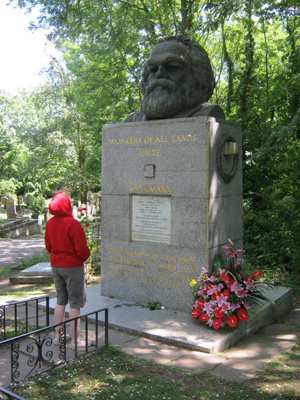
picnic basket full of Monopoly money, some projected video of Marxist texts and
Ward’s encounter with a statue of Marx, and an extensive board of clippings,
mind maps and pop-culture references: a photo ofLouise
Michel, doyen of the Communard; a Karl Marx garden
gnome; paper stickers of grandma and the wolf, a vintage Viewmasterdisk of Little Red Riding Hood, a page from theOccupied
Wall Street Journaldated
October 8th, 2011; a Carl Sandburg poem; the rules of the Monopoly game.
The book which accompanies the show was published in the
fall of 2011 byPointyhead Press. In Ward’s words, “the book is a faithful
homage to the story Little Red Riding Hood with a polemic on class warfare. A
timely account of fear and violence, this project is a response to the current
climate of struggle. Little red is the original occupier, a protestor
willing to be eaten alive for her beliefs.“
With its period typeface and letterpress aesthetic, it deliciously deconstructs
the Red Riding Hood story with humour and astute commentary on the avarice of
the capitalist system.
Who says art and politics shouldn’t mix?A little red shows
us that they are inseparable. There is plenty to chew on in this unpretentious
work which confronts our dark days with research, wit and a dab of theatre. I
haven’t seen too many artists weigh in on the Occupy movement. Victoria Ward
gives us a good place to start.
The Globe and Mail
October 1st, 2011 Critics picks for the
best of Nuit Blanche
A Little Red
55
Mill St., Distillery District
A
radical reworking of Little Red Riding Hood, via Das Kapital, by
performer/painter/writer Victoria Ward, who knows her way around the forest (and
the concrete jungle).
–
R.M. Vaughan
The County Voice
May 6, 2010
by Will Jones
Local
Artists Show the Beauty in the Unnoticed and Forgotten of New York & Haliburton
What do you think New York City and Haliburton County have in
common? ‘Not much at all, thankfully’, would be the answer of most folks that
live around here. However, ask the same question to artists Victoria Ward and
Gary Blundell and their answers, and artworks, will have you viewing both places
in a new light.
Opening on June 4 and running until July 24 at the Agnes Jamieson
Gallery in Minden, the duo’s exhibition, More Paintings About Buildings And
Rocks, is a journey through oft forgotten places urban and rural and frequently
un-noticed patterns manmade and natural. The works exhibited illustrate Ward and
Blundell’s ability to find beauty in the most unexpected of place and their
talent in conveying their finds to us via collections of challenging and yet
beautiful paintings. Ward states that her focus often begins with the discovery
of ruins, recycled items and forgotten things. A sugar shack left to rot in the
bush or the decaying debris of an abandoned industrial site, each slowly being
taken back by nature; these story-filled places provide inspiration. “I like to
convey uncertainty, flux, restlessness and isolation; notions that I believe
inhabit the natural world and the role we play in it,” she says. “My subject
matter often focuses on abandoned shelters or derelict homes that dot themselves
throughout rural areas. They are to me the residues of our need to mark
ourselves onto the land. These lonely little structures convey how nature and
mankind go back and forth in domination. At one time a shack was a home with a
cleared yard, now it is a thicket where woodcocks live. The ineffable area
between the land, its indifference to us, and our need to see our image
somewhere on its surface is where I want my work to exist.”
Wards’ artistic ethos transfers remarkably well into the urban
context. While the glittering towers of Manhattan Island are an almost
artificially cleansed reality, the majority of New York – the Bronx, Brooklyn,
Queens, to name just a few districts – is in constant flux, its streets
witnessing the birth, life and death of countless people and places in a slow
evolutionary cycle. “When we visited New York last year we stayed for the first
time outside of Manhattan Island,” explains Ward, “and it gave us a new
perspective on the city. Suddenly we could see the real New York, the diverse
mix of people, the wildlife along the river, the poor neighbourhoods, the
forgotten and unnoticed places. It opened my eyes to how my artistic focus was
just as relevant in the midst of this metropolis as it is in the outlying rural
areas of Haliburton County.” In response, Ward’s paintings (acrylics on wood)
such as Down Under the Manhattan Bridge Overpass and WTR BKLN present a starkly
beautiful alternative perspective on the city, and, they dovetail wonderfully
with her paintings of forgotten places more local, such as Sugarshack and Camp.
As Ward was inspired by the abandoned and disregarded of New
York, Blundell came to realise that his senses were awakened, heightened even
while in the city. “I got the same feeling in New York as I do when I’m out in
the wilderness,” he says, “that alertness, that need to be on your toes. Also, I
felt anonymous, small, just as you do when you are trekking far from the human
comforts that people are so used to now-a-days. New York is the opposite of
where we live and what we experience everyday but in so many ways it is the
same.” As a trained geologist, Blundell’s artwork often begins with rocks. He is
intrigued by their patterning, their longevity and the tales they can tell of
the slow yet constant changing of the landscape. “In practical terms, I use
rocks as a starting point to explore my interest in patterning,” he explains. “I
create a web of shapes evoking hydroelectric lines, lots and concessions, city
grids, quarries and mines, river systems, tectonic plates, satellites and human
tissue. My paintings reflect landscape as often transformed through development
and always imbued with human memory.” As such, New York is just part of the
evolutionary history of North America and its buildings, roads, sewers and
subway systems more sets of patterns, this time carved out by man, rather than
nature. Blundell takes these patterns and literally carves them into his
paintings. Working on thick plywood, he routers the patterns into it, paints and
routers more – adding and taking away, adding and taking away – to create
exciting patterned artworks that are less immediately understood than Ward’s
paintings and so more challenging to the viewer. The origin of these large
format paintings, with names like Grip, Reviviscence and Elegy can only be
guessed but their patterning, their blurring of life, evokes memories of places
visited be they rural or urban.
Although they are partners in life, Ward and Blundell do not
often show their work together and so it is a rare treat to see how the same
things – lifestyle, journeys, events – can touch two people in different ways.
“We take the same journeys, use the same inspirations but that is where the
similarities end,” says Blundell. “Our work takes on very different characters
from then on.” Ward adds, “What I would say though is that the trip to New York
and this show have brought about a realization that over a decade of our work
about geological events, decomposition and regrowth – the slowest of life’s
events – can be as relevant in the city as it is in nature for both of us.”
Importantly, what this exhibition also does - with its throw away
title that plays on the Talking Heads album ‘More Songs About Buildings and
Food’ - is make the viewer realize that painting, the oldest art form, can be as
powerful, exciting, beautiful and intriguing as any of the more immediate and
unusual mediums that we see artists employing today. Go see it because it’s just
as good as all that art in the city!
The Ottawa Citizen, Critic's Pick
Saturday, May 10, 2008
by Arts Editor, Peter Simpson
Victoria Ward's subjects and materials can change - watercolours or rural
France in 2004, mixed-media images of a scarred Ontario mining town (Cobalt)
this weekend at Artguise - but one thing doesn't change. Always, the
viewer gets the deep, disquieting sense that whatever humans build onto nature
is vulnerable, to nature's dominance, and perhaps even its wrath. man's homes
and buildings seem to tip, swirl, or other wise appear unstable and
transitory. The murky colours in her new exhibition 'rockets & gallows',
draw you beneath your feet. The show contiues to May 28 at Artguise
Gallery, 590 Bank St., across from the Clocktower.
The Thunder Bay Source
November 25, 2005
by Kathryn Lyzun
On Saturday Nov. 26, two of Ontario's most interesting landscape artists are
giving local artists the chance to challenge traditional ideas of landscape
paintings and discover new and rugged contemporary practices. E. G. Blundell,
born in England but a longtime resident of Ontario, and partner in artistry
Victoria Ward of Oshawa, ON, will spend the day helping people develop new ideas
about landscape painting and environmentalism at the Thunder Bay Art Gallery.
Their exhibition is already in place, showcasing Blundell's enormous, bold and
"virile" gouged-wood paintings and Ward's smaller, softer wood and paper
acrylics.
Curator Glenn Allison said the pair's style is a really hands-on, return to the
earth concept that is the modern face of landscape painting. "In the 60's and
70's, landscape atrophied as an art form... the Group of Seven is now three
generations gone. Blundell and Ward represent a new group of talent that is
re-examining landscape, and it's coming up very differently, perhaps
fortunately."
E. G. Blundell and Victoria Ward are two of Canada's best known landscape
artists
Blundell and Ward the make the environment a direct part of their work, using
the plywood canvas as a carving board before it's painted. They use heat guns,
blow torches, hammers and gouging tools to carve out and illustrate their
stories. Blundell, in fact, is not artistically trained: he has a background in
Earth Sciences.
"You see in Blundell a real mining of the wood," Allison said, "It's a shift
from objective representation, as seen in the old landscape style , to direct
engagement. As environmentalism both artists call for a greater depth of
identification with the forces of nature."
Blundell's mesmerizing pieces look geological, like flowing lava or alien
terrain of rock and earth. Ward's are more ethereal , story telling pieces, like
the strangely beautiful "lunar shack" which features a huge glowing moon painted
above a tiny stuck-on photograph of a little shack, dwarfed against the massive
sky.
The pair both strongly believe in their art, and Allison said the workshop will
be wonderful for anyone willing to open his or her mind. "It's a chance to
experiment and explore new ways to discover the earth."
Ottawa Xpress Magazine
April 14th, 2005
Artswatch
Anita Euteneier
INSIDE THE ARTIST'S STUDIO: VICTORIA WARD
I met Victoria Ward at her studio near the hamlet of Gooderham, roughly half way
between Toronto and Ottawa. Surrounded by the rugged Canadian Shield and
spectacular waterfalls, it's easy to see where Ward gets the inspiration for her
paintings. The studio is a former woodshed that she and her partner, landscape
artist E.G. Blundell, designed, converted and now share.
The walls of Ward's studio display postcards of works by favourite artists Tom
Thomson and Anselm Kiefer, a collection of images of the Northern Lights, and
Ward's own poetry. Ward is comfortable with words, having worked for 10 years as
a professional playwright in Toronto. "I learned to write in metaphors, so
images come easily," she told me.
In 1997 she looked around for a new direction and fell into painting-and in
love-when she met Blundell at an art opening. "We started going sketching
together and he was very encouraging," she said. Since then the couple have
painted and exhibited together, most recently in a touring show from the Robert
McLaughlin Gallery in Oshawa.
Ward's early desire to become an artist was encouraged by her mother, a hobbyist
painter who took her to museums and galleries. "I tend to think that people who
step out and decide to take a creative avocation and turn it into a vocation
become aware of their mortality. We don't feel like we have a lot of time, so
it's about leaving our mark."
Ward's works on wood and paper reflect her observations of the natural world. "I
am attracted to human interaction with the land," she said of her paintings that
show barns and houses and hydro poles, but never people. "People get in the way
of the scenery," she said.
Ward fuses text (often poems) with visual images, creating narratives with
universal themes. They are less about a place than a place in time, where even
Icelandic lava fields seem familiar. "Some artists like to be wilfully obscure.
It just doesn't interest me. I think it's the height of arrogance when an artist
says it all comes from the imagination... it's all out there, somewhere."
Ward is not a spontaneous painter. Much of what comes out gestates during long
walks on the country roads near Gooderham and in travels in Canada and abroad.
"Before I put a piece of metal on board, I've drawn it 740 times in my brain,"
she explained.
Outside the studio, a large picnic table serves as a work space for some of
Ward's more hazardous artistic techniques. She often alters wood surfaces with a
router, blowtorch and heat gun to add and remove paint.
Her upcoming exhibition at the Manx Pub in May is called Gamey. The idea came
from a visit to the Louvre where she spent time with paintings by 18th century
genre painters. Ward was struck by still-life paintings of splayed oxen and dead
partridges displayed next to portraits of monarchs.
"Gamey" also refers to Ward's experience of finding roadkill and extricated deer
limbs (left over from hunters) while out walking near her studio. The exhibit
runs May 11 to 31 at the Manx Pub, 370 Elgin Street.
Express Magazine
Ottawa, June 12 - 18, 2003
Precambrian Shield foundation for artists
Sometimes a place leaves such an indelible impression that it must be revisited.
Some two years after an artist residency in Iceland, Gary Blundell and Victoria
Ward have done just that, revisiting Iceland's mystical landscape in drawings
and paintings.
But while their new paintings and drawings incorporate elements of Iceland's
gritty black lava fields, the rocky Precambrian Shield that surround their
isolated studio in Gooderham, Ontario, chiefly informs the work.
Blundell and Ward, who are also life partners, moved to the rural area because
of the landscape and because it's half way between their families in Ottawa and
Orillia. Blundell first visited Gooderham to collect minerals while and earth
sciences student at the University of Waterloo. But Iceland challenged his
notions of landscape.
"In Iceland, the land is very young geologically, " he said in a telephone
interview. "The lava comes out of the volcanoes and flows down over the surface
of the land. When it cools, it forms a surface that's very broken and almost
cellular." It does not look at all like the scraped, old and metamorphically
reorganized Precambrian Shield.
In Waterline, Blundell gouges the wood with a router into small square forms
that take on a pixilated quality. Oil paint is applied with layers of gradated
colours, with green and grays becoming oranges and reds, creating a textured
large-scale work that takes a full week to complete.
"There's a pivot in each painting, when I'm working on it for a few sessions and
it starts to become more about the piece than the information I've selected to
make the piece. It's a natural progression, very expressionistic. Blundell's
exhibition Rock Show opens at Artguise June 13 at 7pm.
Gooderham is an unlikely place to live, , especially for a visual artist with a
a theatre background and big city sensibility, but it's been the fuel for
Victoria Ward's art.
"Living up here it's a funny cliché but you really start noticing nature and how
it changes," she said. In Field and Steam, opening this week at the Manx Pub,
Ward's small, framed paper works with acrylic and pen "are based on the kinds of
things I see from my passenger window in the truck near my home: bulrushes,
wetlands, hydro lines and litter."
Ward also reads form her poetry chapbook, notes from a log cabin, ,published by
Ottawa's Camenae Press at Gallery 101, Nepean Street, on July 10 at 7:30pm.
- Anita Euteneier
From Eye Weekly
The Year in Pictures, December 2001
"The most surprising thing about the last 12 months of art? Not one Stanley
Kubrick or the HAL the Evil Computer Tribute show -- no kaleidoscopic tunnel
rides, no big black slabs, no shiny white rooms and only a handful of psychotic
primates (mostly gallery dealers). What a waste.
Here, then are my 10 Best Art Moments for 2001. Just because I care.
7. Gary Blundell and Victoria Ward at the BUSGallery. The most joyous, straight
out-of-the-tube paintings of the year. Imagine a Pucci pantsuit crafted out of
wood and metal by rural Ontario eco-activists and you're halfway there."
All art work and other media on this website should not be
reprinted or published in any form without the written consent of the artists, hotspurstudio
copyright 2000